


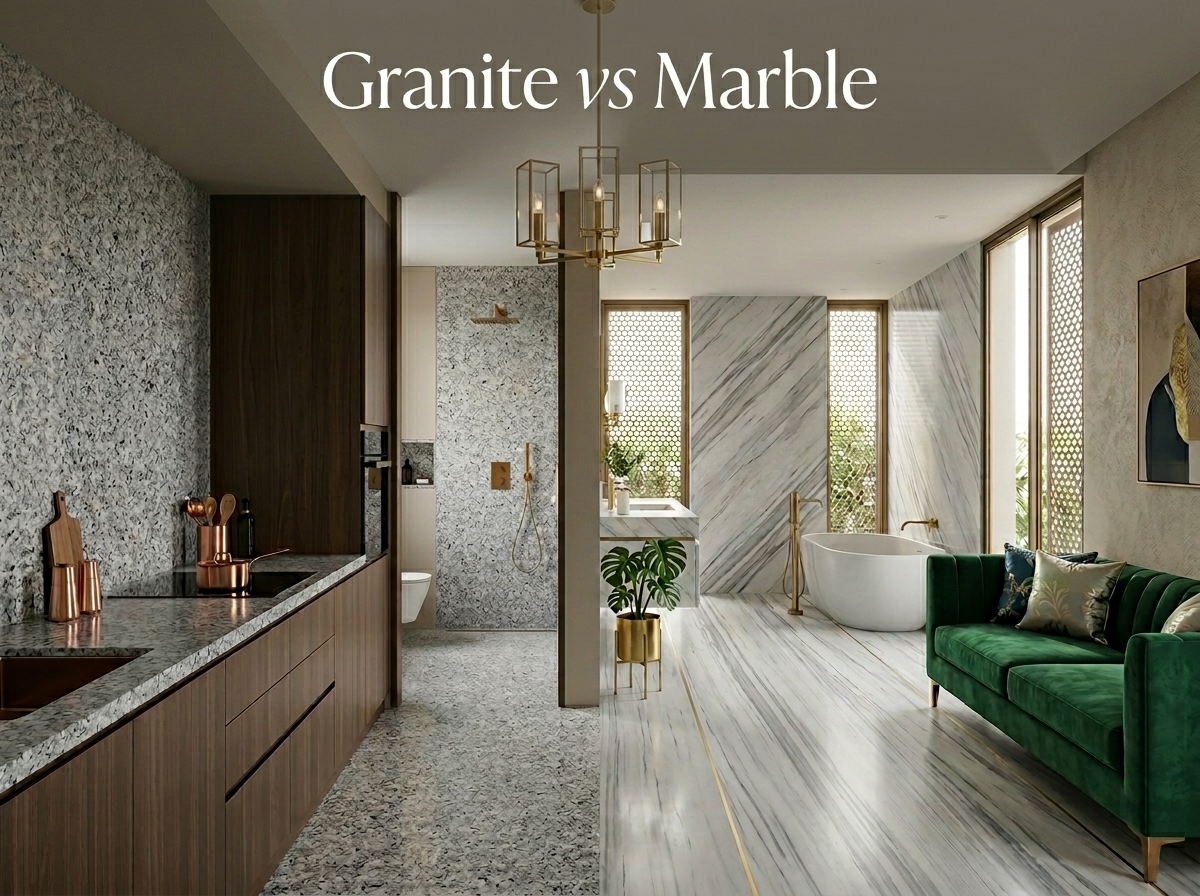
Granite vs Marble — Key Differences at a Glance
30-second summary- Working kitchen countertops
- Busy corridors and primary staircases
- Many exterior paving applications
- Buyers prioritising abrasion resistance
- Projects needing lower day-to-day care
- Formal living rooms and bedrooms
- Pooja rooms and carved details
- Feature walls and vein-led interiors
- Premium bathrooms and hospitality spaces
- Owners who accept marble-specific care
Granite vs Marble — Practical Property Comparison
Compare the actual slabGranite and marble are broad stone families, not single products. Performance varies by mineral composition, porosity, finish, thickness, resin treatment and installation. Use this table as a selection guide, then confirm the exact stone with your supplier and installer.
| Factor | Granite | Marble | Buyer takeaway |
|---|---|---|---|
| Geological family | Commonly sold as hard, silicate-rich dimension stone | Calcitic or dolomitic metamorphic stone; trade usage can be broader | Commercial names alone do not define performance |
| Relative hardness | Many granites are harder and more abrasion resistant | Usually softer and easier to scratch or wear | Granite is generally safer for heavy traffic |
| Acid sensitivity | Usually more resistant to common food acids, though acidic cleaners are still not recommended | Calcitic marble can etch from lemon, vinegar and similar acids | Granite is normally easier in working kitchens |
| Stain risk | Varies by stone and sealer; many dense granites perform well | Varies by marble and finish; light colours can show oil or pigment more readily | Test the selected slab and use suitable protection |
| Heat | Natural stone tolerates heat, but thermal shock and resin can still be damaged | Natural stone tolerates heat, but thermal shock and resin can still be damaged | Use trivets on both materials |
| Visual character | Speckled, crystalline, flowing or uniform patterns | Veined, cloudy or translucent visual movement | Choose from full slabs, not small samples only |
| Wet-area safety | Finish and drainage matter more than the stone name | Finish and drainage matter more than the stone name | Avoid a high polish on frequently wet floors |
| Outdoor use | Many granites are suitable when correctly specified and textured | Some marbles are used outdoors, but suitability is highly stone- and climate-specific | Request an exterior-use recommendation in writing |
| Restoration | Can be refinished if required; frequency depends on wear | Can be honed or repolished when wear or etching becomes visible | There is no universal fixed polishing interval |
| Price | Ranges from economical Indian varieties to rare premium slabs | Ranges from economical Indian varieties to premium imported slabs | Compare total installed cost, not only slab rate |
Granite vs Marble Price in India
Indicative July 2026 planning rangesNatural stone has no universal fixed rate. Price changes with the exact variety, slab grade, dimensions, measured thickness, finish, reinforcement, repairs, quantity, usable yield and delivery scope. The figures below are material-only planning bands, not quotations.
Granite material planning bands
| Category | Indicative material range | Examples |
|---|---|---|
| Entry Indian granite | ₹45–₹90/sq ft | Selected commercial white, pink and grey lots |
| Mid-range Indian granite | ₹70–₹180/sq ft | Steel Grey, Tan Brown, Moon White and similar selections |
| Premium or exotic granite | ₹120–₹350+/sq ft | Selected black, white and exotic lots |
See the granite price per sq ft guide for variety-wise planning.
Marble material planning bands
| Category | Indicative material range | Examples |
|---|---|---|
| Entry Indian marble | ₹40–₹90/sq ft | Dungri, Albeta and commercial white selections |
| Mid to premium Indian marble | ₹80–₹450+/sq ft | Banswara, Ambaji, Makrana and premium white-vein lots |
| Italian and imported marble | ₹200–₹1,500+/sq ft | Carrara, Statuario, Calacatta and other imported selections |
See the marble price in India guide for material and installed-cost planning.
Compare the full project cost
A low slab rate can become expensive when the lot has poor usable yield, heavy repairs, difficult matching or high fabrication requirements.
Room-by-Room Granite or Marble Decision Guide
Match stone to useThe recommendation changes with traffic, water exposure, cleaning habits, desired finish and design intent. Approve the actual slab and finish for the exact location.
Living room
Choose granite for a busy family space or marble for a formal, design-led room where owners accept more careful maintenance.
Kitchen worktop
Many granites are less vulnerable to food-acid etching than calcitic marble. Use a suitable sealer where required and trivets on every natural stone surface.
Bedroom
Both materials can perform well in a dry, lower-traffic bedroom. Marble is often chosen for veining; granite for easier daily care.
Bathroom
Use a slip-conscious finish, correct falls, waterproofing and compatible cleaners. Both granite and marble can be used when properly specified.
Staircase
For busy stairs, abrasion resistance and edge durability are important. Marble can still suit formal staircases with correct thickness and detailing.
Pooja room
White marble is traditionally associated with temple interiors. Select by appearance, soundness, carving needs and cleaning routine.
Outdoor paving
Many granites perform well outdoors in flamed, shot-blasted or other textured finishes. Some marbles are used outdoors, but only after stone-specific suitability review.
Parking or driveway
Choose a dense, textured stone with thickness and bedding designed for vehicle loads. Do not specify by colour name alone.
Granite vs Marble for an Indian Kitchen
Performance-first choiceWhy granite is commonly selected
- Many granite varieties are harder and less acid-sensitive than calcitic marble.
- Dark and mid-tone granites can be more forgiving of daily cooking marks.
- Large slabs reduce joints, but sink and hob openings still need correct reinforcement.
- A penetrating sealer may be useful for some stones; test absorption rather than following a fixed calendar.
- Use chopping boards and trivets. Natural stone and resin repairs are not damage-proof.
When marble can still work
- Design-led islands, pastry zones or controlled-use kitchens where natural patina is accepted.
- Owners understand that lemon, vinegar, tomato and similar acids can etch calcitic marble.
- The selected slab is approved for fissures, reinforcement, thickness and sink-cut-out position.
- Cleaning uses pH-neutral products and spills are blotted promptly.
Read the granite kitchen buying guide for colours, edge profiles, thickness and quotation checks.
Granite vs Marble for Bathroom Floors, Walls and Vanities
Safety and detailing firstFloor selection
Stone name alone does not determine bathroom safety. Choose a finish with appropriate slip performance, provide correct drainage falls and avoid soap or sealer build-up. Honed and textured finishes are commonly considered, but the exact finish must be tested for the project.
Walls and vanity tops
Both granite and marble can be used. Marble offers stronger vein character; granite is often more forgiving around cosmetics and cleaners. Confirm edge details, basin support, waterproofing, grout, cleaner compatibility and whether the stone needs sealing.
Granite vs Marble for Stairs
Traffic and edge design matterGranite for busy staircases
Many granites resist abrasion and edge wear better than marble, making them a practical choice for primary stairs. Specify tread thickness, full bedding, nosing geometry, anti-slip treatment and consistent riser height.
Marble for design-led stairs
Marble can be used successfully in residential and hospitality stairs when the grade, vein orientation, thickness, reinforcement and maintenance plan are appropriate. Inspect every tread for fissures before cutting.
Granite vs Marble for Outdoor Use
Stone-specific approval requiredWhy textured granite is often preferred
Many granites offer good abrasion resistance and are available in flamed, brushed or shot-blasted finishes. Exterior performance still depends on the exact stone, thickness, drainage, bedding, joints, load and climate. Polished exterior walking surfaces can be slippery when wet.
Can marble be used outdoors?
Some marbles have a long history in exterior architecture, while others can weather, bow, stain or lose polish in particular environments. Do not use a universal yes-or-no rule. Ask for project-specific exterior suitability, finish, anchoring or bedding details and maintenance expectations.
Granite and Marble Care: What Owners Should Plan
Test-based maintenanceGranite care
- Remove grit with a clean dust mop to reduce abrasion.
- Use warm water, a neutral stone cleaner or mild dishwashing detergent.
- Blot spills; do not rely on dark colour to hide absorption.
- Use trivets, chopping boards and mats in demanding areas.
- Seal only when the selected stone and absorption test indicate it is useful.
Marble care
- Use pH-neutral cleaners and avoid lemon, vinegar and acidic descalers.
- Blot oil, coloured liquids and acidic spills promptly.
- Use mats at entrances because grit can scratch polished marble.
- A sealer can reduce absorption but does not prevent acid etching.
- Refinish when visible wear justifies it; there is no universal three- or five-year rule.
Care guidance should be confirmed for the exact stone and finish. The Natural Stone Institute recommends neutral cleaners, prompt spill removal and the use of trivets even though many stones tolerate heat.
Traditional Vastu Colour Preferences
Optional cultural considerationVastu recommendations are traditional beliefs, not material-performance standards. Buyers who follow them often prefer lighter stone in north and north-east spaces and warmer or deeper tones in south and south-west areas. Safety, drainage, structural suitability, maintenance and the actual room light should take priority over colour symbolism.
| Space | Common traditional preference | Practical check |
|---|---|---|
| North or north-east | Light white, cream or soft grey | Glare, stain visibility and wet-area slip |
| East-facing rooms | Light or warm neutral tones | Morning light and furniture palette |
| South or south-west | Earthy beige, brown or deeper grey | Heat gain, room size and maintenance |
| Pooja room | White marble is commonly preferred | Oil, kumkum and incense stain protection |
| Kitchen | Warm neutral or red-brown accents | Acid, oil, heat and cleaning performance |
Final Decision: Choose by Application, Not a Universal Winner
Project-specific verdictThe surface will face heavy traffic, working-kitchen use, abrasion, frequent cleaning, stairs or exterior exposure and the selected granite is suitable for that application.
The project prioritises vein character, a formal or traditional look, carved work, feature surfaces or lower-traffic interiors and the owner accepts marble-specific care.
Five questions to answer before ordering
How This Comparison Was Prepared
Reviewed July 2026Editorial method
The guide separates general stone-family behaviour from the performance of an individual slab. Recommendations are based on application, actual lot quality, finish, installation and care rather than declaring one material universally superior.
Price bands are indicative planning ranges. Update them only when the underlying market changes and retain the existing evergreen URL.
Granite vs Marble FAQs
Which is better, granite or marble?
Neither is universally better. Granite is usually more forgiving for kitchens, busy stairs, corridors and many outdoor applications. Marble is often selected for formal interiors, pooja rooms, feature walls and spaces where natural veining is the priority. Confirm the exact stone and finish for the application.
Is granite cheaper than marble in India?
Entry-level prices overlap. Common Indian granite may start near ₹45 per sq ft and commercial Indian marble near ₹40 per sq ft, while premium imported marble can be much more expensive. Compare usable yield, wastage, processing, freight, laying and future restoration—not only material rate.
Is granite or marble better for an Indian kitchen?
Granite is usually the lower-risk choice for a heavily used cooking worktop because many granites are harder and less sensitive to food acids than calcitic marble. Marble can work when the owner accepts etching and staining risk and follows careful use. Use trivets and chopping boards on both.
Which is better for home flooring?
For high traffic and easier care, granite is often preferred. For formal rooms and a veined luxury look, marble may be preferred. Finish, joint layout, slab quality, thickness, laying and maintenance have as much influence as the stone family.
Does every granite or marble need sealing?
No fixed calendar applies to every stone. Sealing depends on absorption, finish, location and the sealer used. Test the installed surface and follow the stone or sealer specialist’s advice. A sealer can reduce absorption but cannot make marble acid-proof.
Can marble be used outdoors?
Some marbles are used successfully outdoors, but other varieties can weather, stain, bow or lose finish in specific climates. Granite is often more forgiving. Ask for stone-specific exterior suitability, thickness, finish, bedding or anchoring and drainage details.
घर के लिए ग्रेनाइट या मार्बल कैसे चुनें?
किचन, ज्यादा ट्रैफिक वाली सीढ़ियों और आउटडोर एरिया में सही फिनिश वाला ग्रेनाइट आमतौर पर ज्यादा practical होता है। फॉर्मल लिविंग रूम, पूजा घर और feature wall में मार्बल का प्राकृतिक vein pattern बेहतर लग सकता है। Final decision actual slab, thickness, finish, wastage, maintenance और total delivered cost देखकर लें।
Ready to Choose? Get Expert Help + Factory Prices
Share your room type, dimensions, preferred look, delivery city and budget. The team can share current stock options, slab videos, specifications, processing choices and a dated quotation.
- Current granite lots across multiple colours and price bands
- Indian, Italian and other imported marble options
- Itemised material, processing and delivery quotation
- Pan India delivery with wooden crate packaging
- Free expert consultation — granite vs marble for your home